Best Roofing Material for New Jersey Homes
Which roofing material suits New Jersey weather? Asphalt, metal, composite tile, slate, cedar and flat membranes ranked for NJ climate and cost.
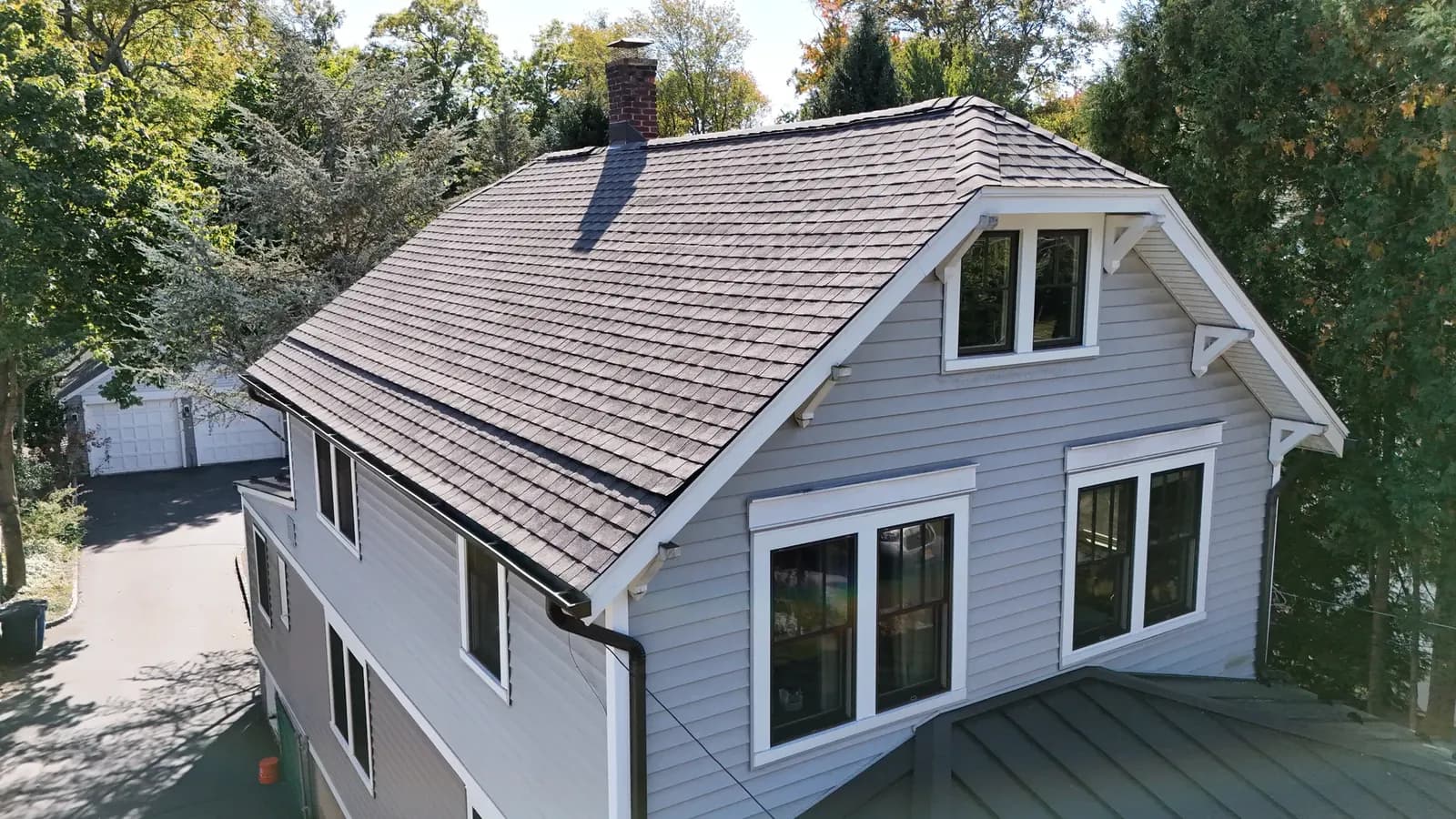
For most New Jersey houses, architectural asphalt shingles are the right roofing material: they handle freeze-thaw winters and offer a range of shingle systems. Roof size, pitch, removal and access shape their installation scope. Metal is the stronger choice if you plan to stay for decades. Composite tile is the answer when you want a slate or cedar look without the weight or the upkeep. Natural slate and cedar suit particular houses, and flat sections need a membrane, not shingles.
“Best” here is about the material and the climate, not about any contractor. Here is the ranking and the reasoning behind it.
The Short Answer
- Architectural asphalt shingles: the default, and right for most pitched roofs.
- Metal ( or metal shingles): the long-haul choice.
- Composite tile: slate or shake looks at a fraction of the weight.
- Natural slate: superb on houses built for it, a burden on houses that were not.
- Cedar shake: beautiful, and the most maintenance in a humid state.
- membranes: not a rival to the others, the correct cover for flat sections.
What New Jersey Weather Does to a Roof
NOAA’s state climate summary for New Jersey puts statewide precipitation at 47.6 inches a year, with the north-central part of the state near 50 inches. Damaging nor’easters are most common from October through April, and the state sees at least one coastal storm every year. Four forces follow from that:
- Freeze-thaw. Water that gets into a crack freezes, expands and widens it. Porous or brittle materials suffer most.
- . Heat leaking into the attic melts snow that refreezes at the eaves and backs water under the roofing.
- Wind-driven rain. Nor’easters push rain sideways for hours, which tests edges, starter courses and more than the field of the roof.
- Humidity and shade. Wooded lots in towns like Wayne, Montclair and Franklin Lakes keep roofs damp, which feeds algae, moss and rot.
A good New Jersey roof shrugs off all four. Here is how each material does.
NJ Roofing Materials, Ranked
1. Architectural asphalt shingles
Laminated shingles cover most roofs in Bergen County for good reason. The estimate depends on the shingle system, roof layout, removal and deck condition. A product like GAF Timberline HDZ® is for fire, ASTM D3161 Class F and ASTM D7158 Class H for wind, and UL 2218 Class 3 for impact, and it carries algae-resistant granules for shaded lots. The InterNACHI life expectancy chart gives architectural asphalt about 30 years. The weakness is ice dams on poorly ventilated attics, which is a fault of the attic more than the shingle. More detail is on the asphalt roofing page.
2. Metal roofing
Metal lasts 40 to 80 years on the InterNACHI chart, and its slick surface can shed snow. Panel type, seams, flashing and access affect the installation scope. Metal shingles such as GAF TimberSteel™ are UL 2218 Class 4 for impact and ASTM D3161 Class F for wind, and they nail on like a shingle. Over doors and walkways, metal needs snow guards. More on the installation and cost drivers is in metal roof vs shingles cost in NJ, and the systems are on the metal roofing page.
3. Composite tile
Composite (synthetic) slate and shake are molded from polymers to look like the natural material. Brava’s Old World Slate weighs 311 pounds per square, is rated Class 4 for impact, is listed as freeze-thaw resistant, and is tested to 188 mph winds with nails. Its Class A fire rating requires a fire-rated , so specify that. For a Tudor in Englewood or a colonial in Morristown that calls for slate, this is how to get the look on an ordinary roof frame. See the synthetic roofing page and synthetic slate vs natural slate.
4. Natural slate
Slate is the long-life champion, at 60 to 150 years on the InterNACHI chart, and it does not care about freeze-thaw if the stone is sound. The problems are weight and cost. The same Brava page cites natural slate at 800 to 1,500 pounds per square, several times composite tile, and many frames need reinforcing before it goes on. Repairs need a slater, and walking the roof breaks pieces. Slate is right where a house was built for it and the owner wants to preserve it.
5. Cedar shake
InterNACHI puts wood roofing at about 25 years, and in New Jersey reaching that number takes work. Humid summers and shaded lots keep cedar wet, so it grows moss and splits unless it is cleaned and treated on a schedule. Cedar is lovely on the right house in full sun; for most owners who want the look, a composite shake or a shake-look shingle like the one in the photo above is the more practical route.
6. Low-slope membranes
Porches, rear additions and dormers with very little pitch need a membrane. InterNACHI lists rubber at 15 to 25 years, modified bitumen at about 20 and at 7 to 20. Standing seam metal also works on many low slopes. None of these compete with shingles on the main roof; they are what goes where shingles cannot.
Side-by-Side Comparison
| Material | Typical lifespan | Weight per square | NJ climate fit |
|---|---|---|---|
| Architectural asphalt | About 30 years | 235 lb and up | Strong; ventilation decides ice dams |
| Metal | 40 to 80 years | Light | Strong; sheds snow, needs guards over doors |
| Composite tile (Brava slate) | Not on the InterNACHI chart | 311 lb | Strong; Class 4 impact, freeze-thaw resistant |
| Natural slate | 60 to 150 years | 800 to 1,500 lb | Strong if the frame can carry it |
| Cedar shake | About 25 years | Light | Weak under shade and humidity |
| EPDM, TPO, modified bitumen | 7 to 25 years | Light | For low-slope sections only |
Lifespans are from InterNACHI. Asphalt weight is the minimum in the Cost vs Value specification; composite and slate weights are from Brava. For how these numbers play out on real roofs, see how long roofs last in NJ.
To see every roofing material side by side, with sources, open our roofing materials comparison.
The Installation Matters as Much as the Material
Most roofs that fail early in New Jersey fail at the edges, the flashing or the attic, not in the field of the material. The Insurance Institute for Business and Home Safety built its FORTIFIED Roof™ standard around exactly those weak points: a sealed so water cannot enter if the covering tears off, a wider and adhered , and ring-shank nails in an enhanced pattern. Shingles used on a FORTIFIED Roof™ must carry the top wind ratings. Whatever you choose, ask how the deck, the edges and the will be handled.
How Future Remodeling Handles This
Future Remodeling (FHRG LLC, 37A Woodbine St, Bergenfield, NJ 07621, (201) 371-5515, #13VH13329600) installs GAF Timberline HDZ® and UHDZ shingles, GAF TimberSteel™ and Drexel standing seam metal, and Brava composite tile. The company is GAF , GAF Metal Certified, Brava Authorized and FORTIFIED Certified through IBHS.
The in-home estimate is free. Whoever you hire, ask for more than one material priced on the same roof, in writing, so you can compare them directly. Work covers New Jersey and Westchester County, NY, with Bergen County the largest share; the service areas page lists the towns. The warranty page sets out what each manufacturer’s document actually says. All roof types are on the roofing page.
Your project consultant reviews roof size, pitch, layers, materials and access at the free inspection and gives an exact written estimate for the recommended scope.
Frequently Asked Questions
What roof lasts longest in New Jersey?
Natural slate, at 60 to 150 years on the InterNACHI chart, followed by metal at 40 to 80. Both depend on correct flashing and fasteners, which usually fail before the slate or the steel does.
Is cedar shake a good idea in NJ?
It can be, on a well-ventilated roof with sun exposure and an owner willing to maintain it. Under heavy tree cover in humid summers, cedar grows moss and rots early. A composite shake gives the same look with far less upkeep.
Which roofing material handles ice dams best?
No material prevents them on its own. Ice dams form when attic heat melts snow that refreezes at the cold eaves, so air sealing, insulation and ventilation are what stop them on any roof. Ice barrier membrane at the eaves limits the damage when one forms. Metal can shed snow, but where snow guards hold it in place it behaves much like snow on any other roof.
What should a flat roof in NJ be covered with?
A membrane made for low slopes, such as EPDM, TPO or modified bitumen. Shingles need enough pitch to shed water and leak when used on nearly flat sections.
Recap
- Most NJ homes: architectural asphalt, with good attic ventilation and ice barrier.
- Staying for decades: metal, with snow guards where people walk.
- Slate or shake look on a normal frame: composite tile.
- Historic slate: keep it and repair it if the frame was built for it.
- Flat sections: a membrane, never shingles.
To find out which of these suits your house, get a free estimate.