Vinyl Gutters: Pros, Cons, Cost and When They Make Sense
Compare vinyl gutters with seamless aluminum for NJ homes. Learn how seams, access and drainage affect the scope and get a free inspection.
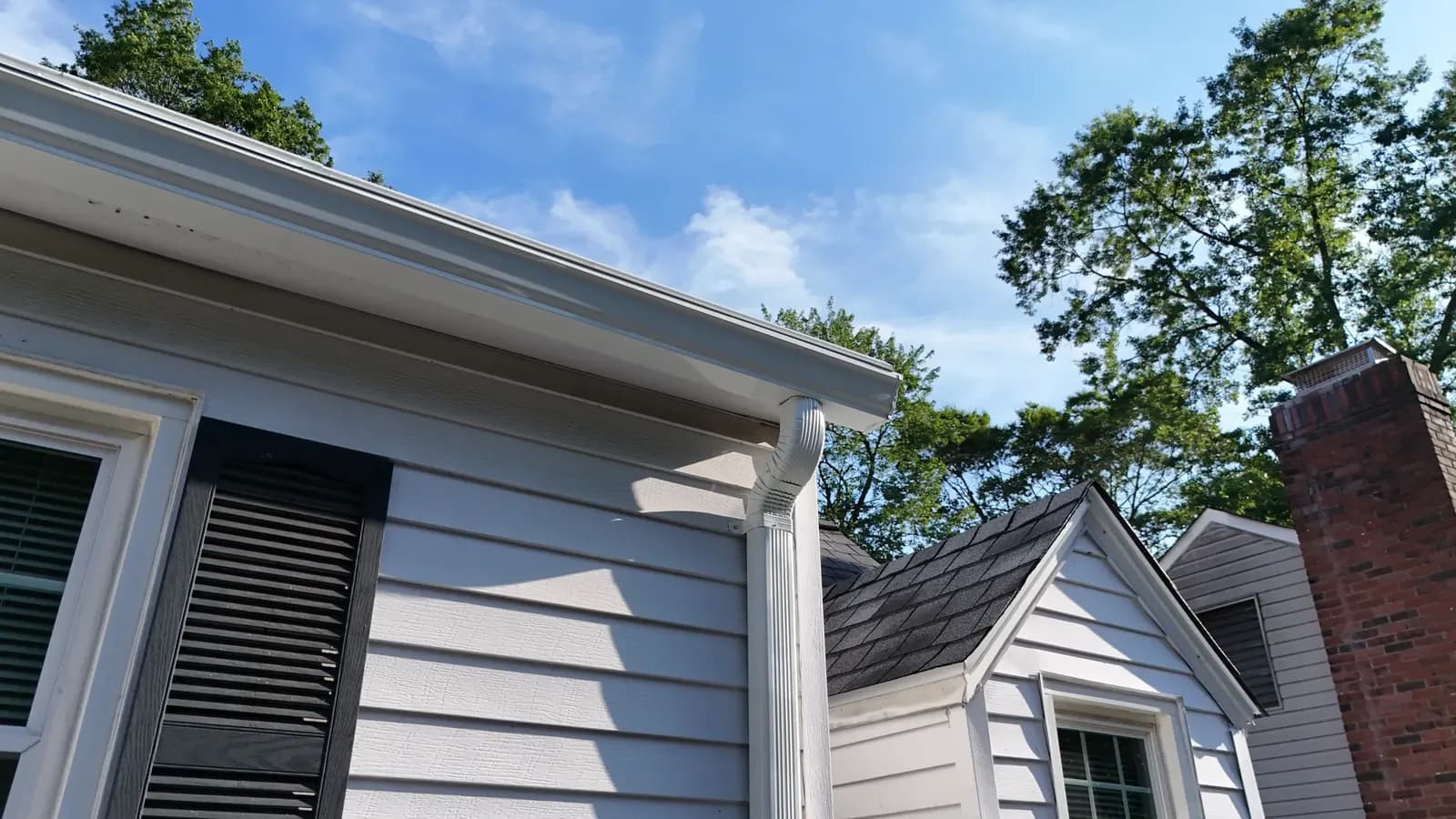
Vinyl gutter installation depends on run length, seams, outlets, access and condition. Vinyl can last up to 20 years, closer to 10 in severe weather, while maintained aluminum can reach 30. Vinyl can suit a shed, garage or short run; seamless aluminum often suits a house exposed to New Jersey winters. Your project consultant gives an exact written estimate at the free inspection.
Here is how vinyl gutters are built, what shapes an installation estimate, how they behave in a New Jersey winter and the situations where they make sense.
What Vinyl Gutters Are
Vinyl gutters are extruded PVC channels sold in short, fixed lengths. The Amerimax vinyl gutter line is typical: a traditional profile in a 5 inch width and a contemporary profile in 4 and 5 inch widths, both in a standard 10 foot length. Every part of the system, from the hangers to the end caps and drop outlets, is a separate moulded piece.
Because each length is only 10 feet, a 40 foot eave needs at least three joints, plus an outlet and two end caps. Each joint relies on a rubber or urethane gasket. Amerimax’s installation guide for its traditional vinyl system has you count sections by dividing the roofline by 10 feet, then fasten each joiner with two small self-tapping screws through the top edge.
The same guide spaces the hooks 18 to 24 inches apart and asks for one end of a run to be free to slide, so the plastic can grow and shrink with temperature. That detail matters more than anything else about vinyl, and we come back to it below.
If you are still learning the names of these pieces, the parent guide to what the parts of a gutter are called walks through every component.
What Vinyl Gutters Cost
Compare the complete gutter system rather than the trough material alone. Run length, corners, outlets, , removal and repairs to the fascia all affect the scope. Access and roof height also determine how the crew can safely carry out the work.
For the same house, sectional vinyl and seamless aluminum require different fittings and installation methods. Ask for proposals that cover the same drainage layout, removal and fascia preparation. Weigh those details alongside lifespan and maintenance.
| Factor | Vinyl (sectional) | Aluminum (seamless) |
|---|---|---|
| Installation scope | Sectional pieces, joiners and support spacing | On-site forming, corners and outlets |
| Typical lifespan | About 10 to 20 years | Up to about 30 years with maintenance |
| Joints on a 40 foot run | Three or more gasketed joints | None between corners and outlets |
| Common sizes | 4 and 5 inch | 5 and 6 inch K-style, half-round |
| Cold weather | Stiffens and can crack on impact | Dents rather than cracks |
| Who installs it | Often the homeowner | A contractor with a forming machine |
Vinyl vs Seamless Aluminum
The biggest difference is not the material. It is the number of joints. A is formed on site from a coil, cut to the exact length of each eave, and has joints only at the corners and at the outlets. A vinyl gutter has a joint every 10 feet, and every gasket is a place where a leak can start once the rubber hardens.
Lifespan follows from that. HomeAdvisor says aluminum gutters can last up to 30 years with proper maintenance, and Fixr expects PVC gutters to last 15 to 20 years. A guide from gutter-guard maker LeafFilter gives a wider band, 10 to 15 years in its cost comparison and up to 20 years with careful maintenance.
Capacity is the third difference. Vinyl tops out at 5 inches. Seamless aluminum comes in 5 and 6 inch and in , and the 6 inch size carries noticeably more water, which matters on a steep or large roof that sends a heavy sheet of rain to one corner. See the K-style gutter page and the half-round gutter page for what each profile looks like on a house.
Vinyl does win on two points. It never rusts, and it is light enough that one person can hang a short run with a drill, a level and a hacksaw.
To see every gutter material side by side, with sources, open our gutter materials comparison.
How Cold Affects Vinyl
PVC gets stiffer as the temperature drops. LeafFilter’s comparison notes that frigid temperatures may make the material brittle and prone to cracking when it is hit by ice or snow, and Fixr says PVC gutters are not particularly resistant to cold weather and can crack in frosty conditions. A gutter that shrugs off a ladder in summer can split when a slab of ice slides off the roof in February.
That is a real concern here. The Office of the New Jersey State Climatologist reports that annual snowfall averages 40 to 50 inches in the northern part of the state, with coastal storms most frequent between October and April. Snow that melts on a sunny afternoon and refreezes overnight loads a gutter with ice again and again through a Bergen or Morris County winter.
Expansion is the other half of the problem. A plastic run grows on a hot afternoon and shrinks on a cold night, which is why Amerimax’s guide calls for a free-sliding end and cuts final lengths using temperature marks on the drop outlet. When an installer screws every piece down tight, the gutter has nowhere to go. It buckles in summer and pulls joints apart in winter.
Leaves add weight. Oak and maple drop most of their load in late October and November, right before the first hard freeze, and a 5 inch vinyl channel full of wet leaves and then ice is carrying far more than it was designed around.
When Vinyl Gutters Make Sense
Vinyl is a reasonable choice in a few specific cases:
- Outbuildings. A shed, detached garage or pool house with a short, low eave and little tree cover.
- A short-term property. A house you plan to sell or rebuild within a few years, where the lower first cost outweighs lifespan.
- Do-it-yourself runs. A single-story eave you can reach safely and want to hang yourself over a weekend.
- Matching an existing vinyl system. Replacing one damaged length on a system that is otherwise sound.
It is a weaker choice on a two-story house, under mature oaks or maples, below a steep roof that sheds ice, or anywhere you want the gutters to outlast the next roof. Gutters in New Jersey are also ordinary maintenance under N.J.A.C. 5:23-2.7, so replacing them does not need a construction permit whichever material you choose.
If you are weighing a full replacement, our guide to seamless gutter installation in NJ covers how a seamless run is measured, formed and hung.
How Future Remodeling Handles This
Future Remodeling installs seamless K-style and half-round gutters, formed on site. See the gutters page for the systems and colors available.
The work covers New Jersey and Westchester County, NY, with most jobs in Bergen County. The service areas page lists the towns, from Teaneck and Englewood to Wayne and Morristown.
Future Remodeling is FHRG LLC, 37A Woodbine St, Bergenfield, NJ 07621, (201) 371-5515, New Jersey home improvement contractor license 13VH13329600. The in-home estimate is free. Whoever you hire, ask the installer to check the fascia and roof edge the gutters will hang from before preparing an estimate.
Frequently Asked Questions
Do vinyl gutters crack in the cold?
They can. PVC stiffens as it gets colder, and a gutter that would flex under a falling branch in July can split under the same blow in January. Ice sliding off a roof is the most common cause in northern states.
Can vinyl gutters be painted?
Yes, with a paint made for vinyl, but a dark color absorbs more sun and makes the sections expand and contract more. Most owners stay with the factory white, brown or grey.
Are vinyl gutters seamless?
No. Vinyl is sold in 10 foot lengths and joined with snap-in connectors. Seamless gutters are formed on site from a coil of aluminum, steel or copper, so the run has no joints except at corners and outlets.
How long do vinyl gutters last?
Plan on 10 to 20 years. Sun exposure, freeze-thaw cycles and how often the joints are disturbed by ladders and ice decide where a particular system lands.
Recap
- Run length, seams, access and fascia condition shape the written installation estimate.
- Expect 10 to 20 years from vinyl and up to 30 from maintained aluminum.
- Vinyl has a gasketed joint every 10 feet; seamless aluminum has none mid-run.
- Cold makes PVC brittle, so snow and ice loads matter when choosing gutters.
- Vinyl fits outbuildings, short-term houses and small DIY runs.
If you want seamless aluminum sized for your roof, get a free estimate.