Hardie® vs Vinyl Siding: an Honest NJ Comparison
Hardie® costs more than vinyl and recoups more at resale. Fire, moisture, fading, upkeep and when vinyl is the right call in NJ.
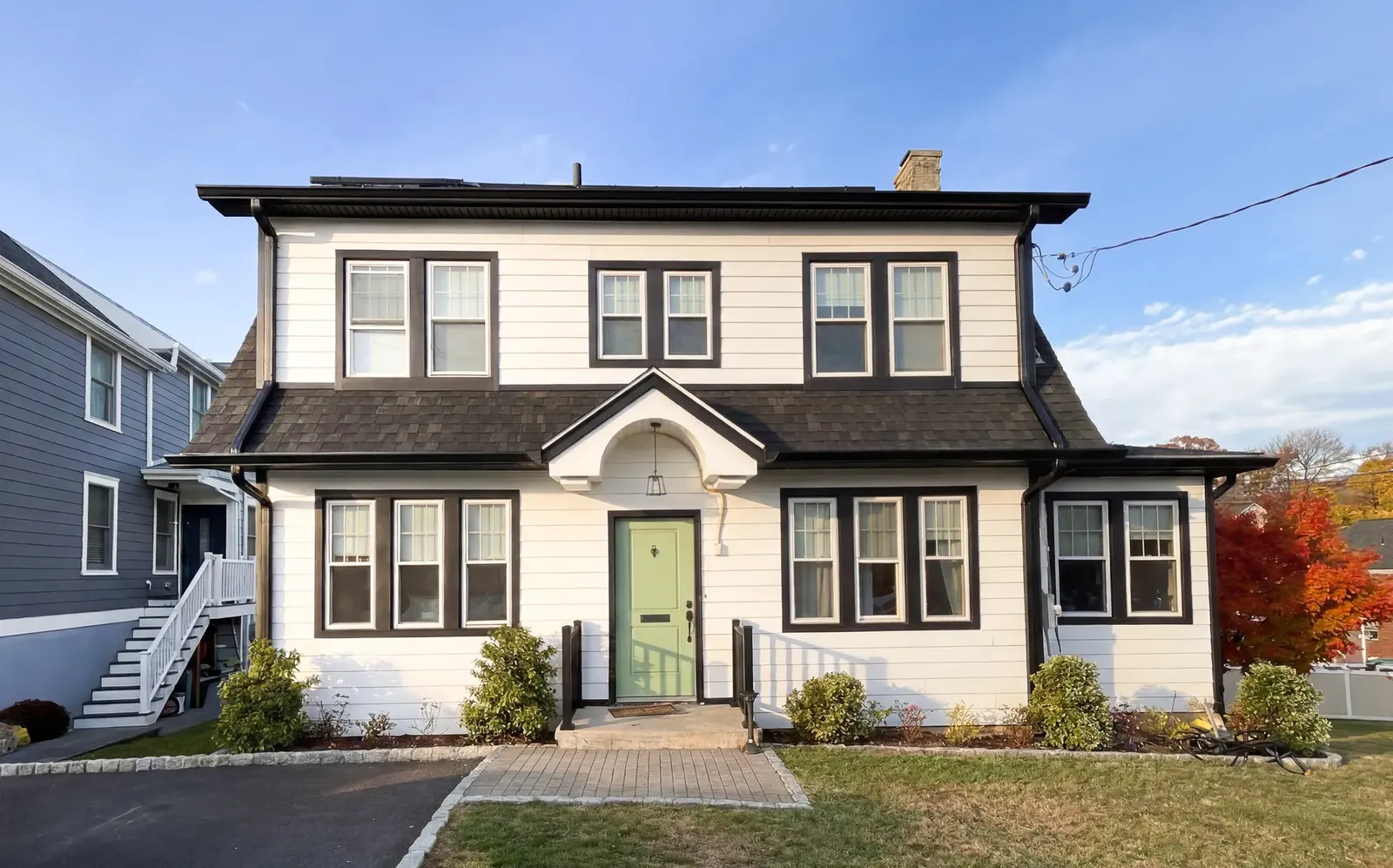
Hardie® fiber cement and vinyl need different installation methods. Fiber cement involves heavier boards and dust controls; vinyl needs room to move with temperature. Wall area, removal, condition, trim and finish choices shape the estimate. Your project consultant gives an exact written estimate at the free inspection.
Neither one is the wrong answer for every house. Here is how they compare on the things that matter on a New Jersey house.
The Short Answer, Side by Side
| Factor | Hardie® fiber cement | Vinyl |
|---|---|---|
| Installation cost drivers | Board handling, cutting, fastening and finishing | Panel profile, movement allowance and trim details |
| Fire | Noncombustible per ASTM E136 | Combustible, can melt |
| Movement with temperature | Minimal | Half an inch or more per 12 ft 6 in panel |
| Paint | Needs repainting over time | Never painted |
| Installation | Heavy, silica dust controls, zone-specific instructions | Light, fast, must hang loose on its nails |
The sections below explain how the materials differ in fire behavior, movement, maintenance and installation. Compare those needs with the written scope for your house and how long you plan to own it.
To see every siding material side by side, with sources, open our siding materials comparison.
Cost, Up Front and at Resale
Compare both materials on the same measured walls. Removal, , , trim and any painting need to be included in each scope. Height and access matter as well as the siding itself.
Resale depends on the house, the local market and the timing of a sale. Choose the appearance, maintenance and installation details that suit your plans for the home, rather than treating a national resale survey as a promise.
For more on the cost drivers for each material, see how much siding costs in NJ.
Durability in New Jersey Weather
New Jersey asks a lot of siding: freeze and thaw all winter, nor’easter rain driven sideways, hot humid summers and, near the coast, salt air.
Vinyl moves. The Polymeric Exterior Products Association says a panel can expand and contract half an inch or more over 12 feet 6 inches, which is why vinyl that was nailed tight ripples in August. It also gets stiffer in the cold, and Consumer Reports notes that some siding is far less resistant to cracking from impacts than others. A snow shovel, a baseball or a string trimmer in February is the usual cause.
Fiber cement is stable but relies on its finish. James Hardie says its HZ5 products are built to resist shrinking, swelling and cracking after years of wet or freezing conditions, and the same FAQ says fiber cement is five times thicker than vinyl. The caveat, from Consumer Reports, is that fiber cement can be damaged by water during freezes and thaws if its paint is allowed to degrade. Keep the paint and caulk in good shape and it stays sound.
On wind, Consumer Reports found that the strongest performers in its testing stayed attached at simulated winds above 150 mph. Installation, especially nailing, matters more than the material.
Fire and Moisture
James Hardie states that its siding is verified noncombustible per ASTM E136 and that vinyl siding is combustible and may be vulnerable to heat-related damage. The same page is careful to say that no siding product is fireproof and that the fire resistance does not extend to the paint. A familiar example is a grill set too close to a wall: vinyl warps or melts, while fiber cement ends up with scorched paint.
Neither material is the waterproof layer of your wall. Both shed most rain and let some get behind them, which is why the , window flashing and underneath matter as much as the siding. Fiber cement adds its own details, such as the 6 inch wide flashing behind butt joints that overlaps the course below by 1 inch, from James Hardie’s lap siding installation tips.
Color, Fade and Maintenance
Vinyl’s color is in the material, so it never needs paint, and a hose and a soft brush are the whole maintenance plan. Consumer Reports notes it is more prone to color change under ultraviolet light, so a dark vinyl on a south wall can drift lighter over the years, and you cannot repaint it easily to match a replacement panel.
Fiber cement arrives primed or with a factory finish. James Hardie says its finishes are UV-resistant and that field-applied paint can dull substantially over time. Consumer Reports adds that fiber cement must be refinished periodically, though less often than wood. The upside of paint is choice: you can change the color of a Hardie® house in Montclair in a weekend of scaffolding. A vinyl house stays the color you bought.
Installation Is Not the Same Job
Vinyl goes up fast. The skill is in leaving room for movement: the panel hangs on the nail with about 1/32 inch of clearance under the head, and when it is installed below 40 degrees F the gap at corners and trim grows to 3/8 inch, per the Polymeric Exterior Products Association.
Fiber cement is heavier, slower and dustier. Federal OSHA silica rules require power saws cutting fiber-cement board to carry a dust collection system. James James Hardie recommends blind nailing and publishes separate instructions for each climate zone, and it puts a typical installation at seven to 14 days. A crew that installs vinyl well will not automatically install fiber cement well, which is why we wrote a separate guide to Hardie® siding installation in NJ.
When Vinyl Is the Right Call
Vinyl is the sensible choice more often than fiber cement marketing suggests:
- The budget is fixed and vinyl lets you do the whole house now instead of half of it.
- It is a rental or a house you expect to sell within a few years.
- You want zero painting, ever, and are happy with the color you choose today.
- You are matching existing vinyl on an addition or a detached garage.
- The walls are shaded, tucked away and out of reach of mowers and kids’ games.
Fiber cement earns its price on a house you plan to keep, where you want a painted wood look, better fire behavior and the option to change color later.
How Future Remodeling Handles This
Future Remodeling (FHRG LLC, Bergenfield, NJ, #13VH13329600) installs both. On the fiber cement side that means Hardie® Plank , Hardie® Shingle and , and the company holds James Hardie™ ALLIANCE Elite tier status. On the vinyl side it means vinyl siding. Details are on the fiber cement siding page, and the siding page covers both.
If you are weighing the two, ask any contractor to price both materials for the same walls, with siding, trim, weather barrier and paint shown as separate lines, so you compare real numbers rather than national averages. The estimate is free and in-home. We work in New Jersey and Westchester County, NY; see service areas. Manufacturer coverage differs between the two materials, and the warranty page sets out what each manufacturer’s document actually says.
Frequently Asked Questions
Is Hardie® siding worth the extra cost?
On resale alone, the 2025 Cost vs Value report says fiber cement replacement recouped more of its cost nationally than vinyl did. Whether it is worth it for you depends on how long you plan to stay, whether you care about a painted wood look, and how much the upfront difference is on your house.
Can you mix Hardie® and vinyl on one house?
Yes, and it is common. A frequent pattern is fiber cement on the street-facing front and vinyl on the sides and rear, or vinyl on a detached garage. The trick is choosing colors and trim details so the change is not obvious at the corners.
Does vinyl siding crack in cold weather?
Vinyl becomes less flexible as it gets colder, so a hard hit in January is more likely to crack a panel than the same hit in July. Installers also leave wider clearances when they hang it below 40 degrees F so the panels can grow in summer.
Does Hardie® siding need to be painted?
It comes either primed for paint or with a factory ColorPlus® finish. Either way the finish is part of the protection, and it will need repainting eventually. Vinyl never needs paint, which is one of its genuine advantages.
Recap: Hardie® or Vinyl?
- Installation: compare material handling, wall preparation, trim and finish requirements
- Resale: local buyers, house condition and timing affect the outcome
- Fire: fiber cement is noncombustible, vinyl is not
- Upkeep: vinyl never needs paint, fiber cement needs it periodically
- Install: fiber cement takes a crew trained on it; vinyl takes care with expansion
To start with your own walls, get a free estimate.