Gutter End Caps: Types, Sizes and How They Are Sealed
End caps close each gutter run. Left vs right, vs , 5 and 6 inch sizes, how they are crimped and sealed, and why they leak.
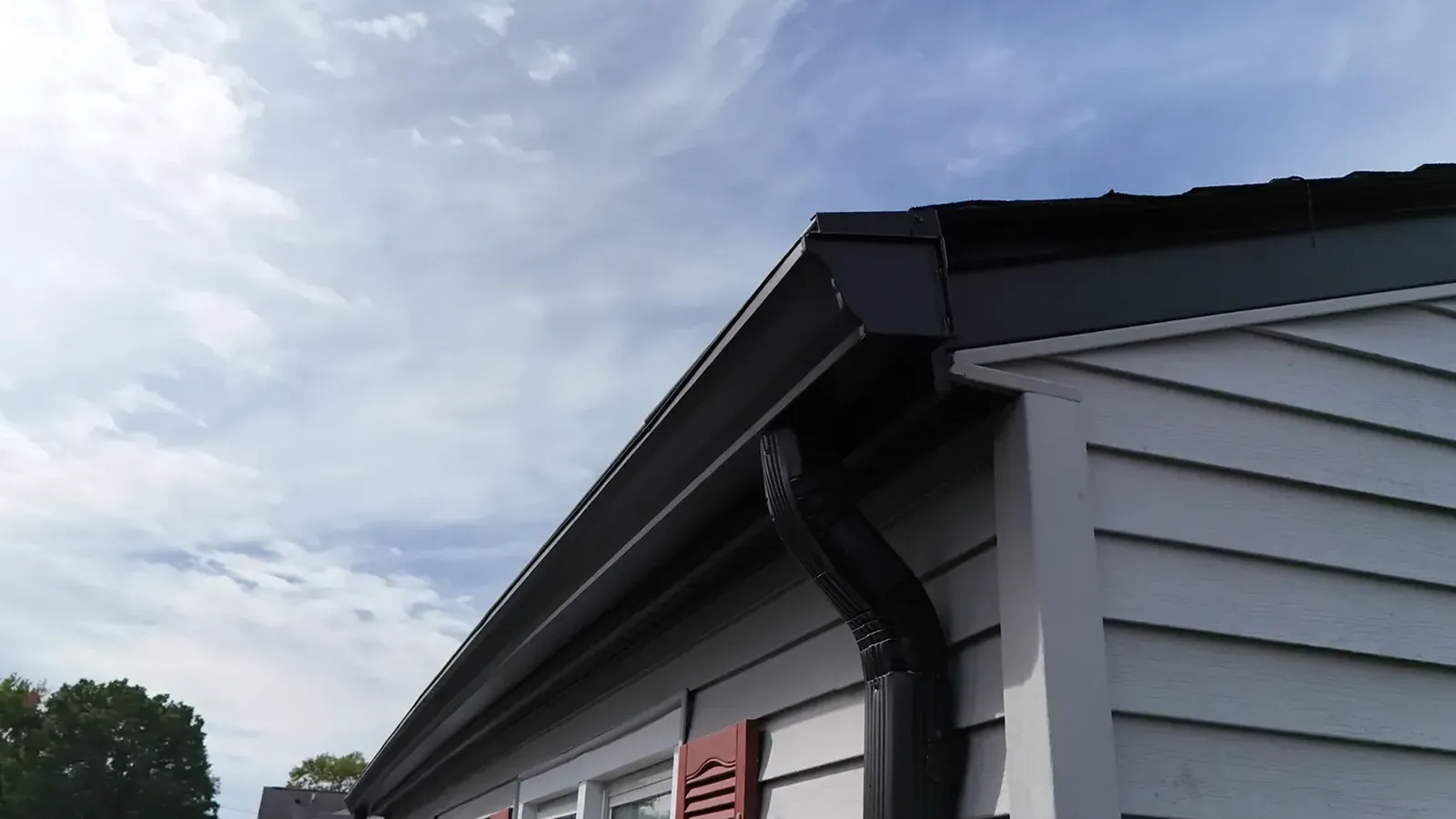
A gutter end cap closes the end of a run so water reaches the outlet. Caps come in left and right versions, in K-style or half-round profiles and in sizes that match the gutter. They are crimped, riveted or screwed in place, then sealed inside. The repair scope depends on profile matching, joint condition, height and access. Your project consultant gives an exact written estimate at the free inspection.
Here is how to pick the right cap, how a good installer seals it, and why end caps are where so many otherwise sound gutters start to drip.
What an End Cap Does
A gutter is a channel open at both ends until something closes them. The end cap is a small, stamped piece, usually aluminum, copper or vinyl to match the gutter, that fits over or inside the cut end. Every run that stops rather than turning a corner needs one, so a typical house has four to eight.
It looks like a minor part, but it is a joint, and joints are where gutters leak. On a seamless system the run between corners has no seams at all, which leaves the caps, corner miters and drop outlets as the connections that depend on sealant.
For where the cap sits in the whole system, see the parent guide to the names of every gutter part.
Left, Right and Universal Caps
K-style gutters have a flat back and a decorative front, so a cap made for one end is the mirror image of a cap made for the other. Suppliers sell them that way. The 5 inch K-style aluminum cap from parts supplier GutterAll is listed in left or right configurations, made from 0.027 inch aluminum, and measures 5 inches across the top, 5½ inches tall and 2½ inches across the bottom.
The convention is simple: face the gutter from the ground, and the cap on your left is the left cap. Some manufacturers make universal caps that flip to fit either end, which is convenient for a homeowner buying one replacement but means checking the fit before crimping.
K-Style vs Half-Round End Caps
The profile of the cap has to match the gutter exactly, including the size of the front bead or hem. A K-style cap is roughly a flat plate shaped to the ogee front. A half-round cap is a half disc, sometimes flat and sometimes domed or with a rolled edge for a more traditional look. GutterAll’s 6 inch half-round end cap measures 6¼ inches wide, 3½ inches tall and 3 inches deep, and is sold as a left, right or matched pair.
| Cap type | Common sizes | Handing | Usual fastening |
|---|---|---|---|
| K-style aluminum | 5 and 6 inch | Left or right | Crimped or riveted, then sealed |
| Half-round aluminum or copper | 5 and 6 inch | Left, right or pair | Sealed, rivets optional; copper may be soldered |
| Vinyl | Matches the vinyl profile, usually 4 or 5 inch | Often left and right | Snapped on with sealant or a gasket |
| End cap with outlet | Matches the gutter | Left or right | As above, with a downspout drop built in |
A 6 inch gutter needs a 6 inch cap. The sizes are not interchangeable, and a cap forced onto the wrong profile leaves gaps that no amount of sealant closes for long. Our K-style gutter page and half-round gutter page show both profiles.
How End Caps Are Fastened and Sealed
On aluminum K-style gutters, the cap is pressed onto the cut end and crimped. The Hunker installation guide says to crimp the cap three times on each side and seal the inside of the joint with caulk. Where there is no crimper, or on rounded caps, two 1/8 inch holes are drilled through the cap and gutter on each side and pop rivets are set, then the inside of the joint is sealed over the rivets. The same guide suggests fitting caps on the ground before the gutter goes up, which is how a seamless run is normally built.
The sealant matters as much as the fastening. GutterAll’s half-round instructions call for a continuous bead of 100 percent silicone or tripolymer gutter sealant on a clean, dry surface and warn against latex or acrylic caulks. Englert describes its Geocel 2321 tripolymer sealant as formulated to prevent moisture penetration through gutter seams, with resistance to heat and weather. Copper caps on half-round systems are often soldered instead.
Good practice, in order:
- Cut the gutter end square and deburr it.
- Clean the inside of the joint area to bare metal.
- Fit the cap and crimp or rivet it tight.
- Lay the sealant on the inside of the joint, where water stands.
- Tool it smooth and let it cure before the gutter takes water.
Why End Caps Start to Leak
Most end cap leaks trace back to one of four causes.
- Standing water at the cap. Amerimax calls for a minimum slope of ¼ inch per 10 feet toward the outlet. A gutter hung flat, or one that has sagged, holds water against the cap and the sealant softens.
- Freeze-thaw movement. Aluminum and sealant expand and contract at different rates. The New Jersey State Climatologist notes that the northern highlands average only 163 freeze-free days a year, so a joint here goes through a long season of daily swings that work old sealant loose.
- Ice and leaves. A gutter full of oak leaves in November dams water at the cap. When that water freezes, the ice pushes outward on the cap and can break the seal or pop rivets.
- Sealant applied outside, not inside. A bead on the outside of the joint looks tidy and does little, because the water is pressing from inside.
A drip at the very end of a run, or a dark streak on the below a corner of the house, usually points at the cap. If several caps and corners on an older sectional system are all leaking, the system is near the end of its life. The guide to seamless gutter installation in NJ covers replacement. Either way, gutter repair and replacement count as ordinary maintenance under New Jersey’s N.J.A.C. 5:23-2.7, with no permit needed.
How Future Remodeling Handles This
Future Remodeling installs seamless K-style and half-round gutters, formed on site. The gutters page has the details. With any installer, ask how the end caps will be fastened and sealed, and what slope the run will have toward each outlet.
Service runs through New Jersey and Westchester County, NY, with Bergen County the largest share; see service areas. Contact: FHRG LLC, 37A Woodbine St, Bergenfield, NJ 07621, (201) 371-5515, New Jersey home improvement contractor license 13VH13329600.
Frequently Asked Questions
How do I know if I need a left or a right end cap?
Stand on the ground facing the gutter. The cap on the end to your left is a left cap and the one to your right is a right cap. Some caps are universal and fit either end, so check the packaging.
Can I just caulk over a leaking end cap?
Caulk smeared over the outside of a wet, dirty joint rarely lasts a season. The fix that holds is to clean the inside of the joint to bare metal, let it dry, and lay fresh gutter sealant on the inside where the water sits.
Do seamless gutters have end caps?
Yes. Seamless means no joints along the run, but every run still needs a cap at each closed end. On a typical house that is the main place a seamless system can leak, along with corners and outlets.
How long does gutter sealant take to cure?
Plan on at least a day of dry weather. Product instructions commonly call for 24 to 48 hours before the joint takes water, longer in cold weather, which is one reason end cap repairs are easier in spring and early fall.
Recap
- End caps close each gutter run and are a common leak point.
- K-style caps are handed left or right; match the size, 5 or 6 inch, exactly.
- Half-round caps follow the half-round profile and are often sold in pairs.
- Crimp or rivet, then seal on the inside with tripolymer or silicone gutter sealant.
- Leaks start where water stands at the cap, where ice forms, or where old sealant fails.
If your end caps keep dripping, get a free estimate.