Gutter Brackets and Hangers: Types, Spacing and Which to Use
Space gutter hangers 24 to 32 inches apart, closer under snow and ice. The four hanger types, screws vs spikes, and what the must hold.
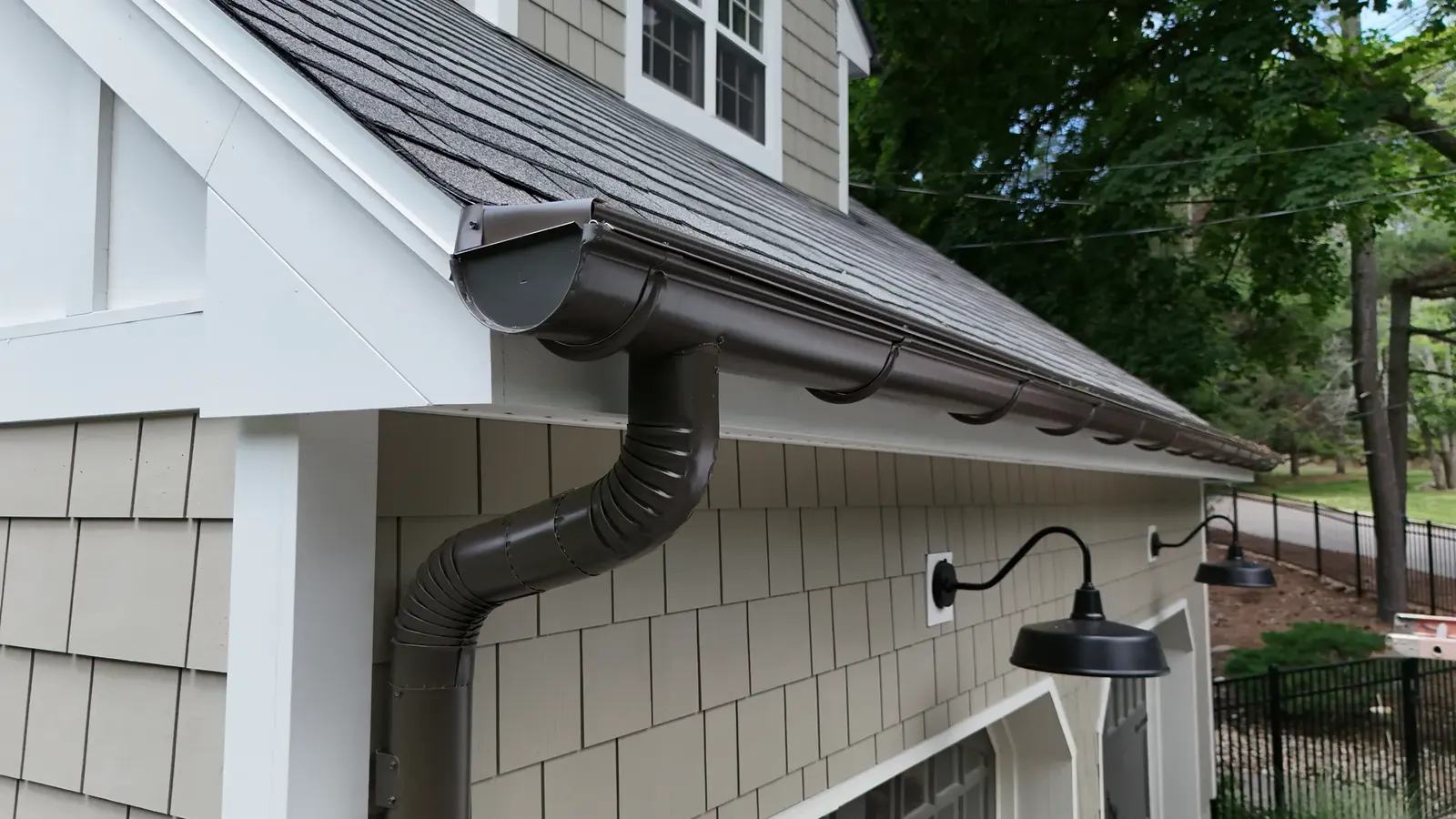
Space gutter hangers no more than 32 inches apart, and 24 inches apart where snow and ice load the gutter, as Fine Homebuilding and This Old House both advise. For a seamless , a screw-in hidden hanger is the usual choice. sit in brackets, and roof straps are for eaves with no fascia.
This guide covers the four hanger types, how spacing changes with climate, why screws replaced spikes, and how to tell whether the board behind the gutter can hold any of them.
What Gutter Hangers Do
A hanger has two jobs. It holds the gutter at the right slope, and it carries the weight of whatever ends up inside: water in a downpour, wet leaves in November, and ice in February. A 5 inch K-style gutter full of water weighs far more than the empty aluminum. In winter the load grows another way: wet leaves and slush hold water in the channel, ice and snow build up along the roof edge above it and bear down on the gutter lip, and water that freezes inside the gutter expands and pushes against every joint.
Slope is set when the hangers go in. Amerimax calls for a minimum slope of ¼ inch for every 10 feet of gutter. The installer snaps a chalk line along the fascia at that pitch and fixes each hanger to it, so a hanger that loosens later changes the slope as well as the support.
For the names of the other components the hangers work with, see the parent guide to the parts of a gutter and what they are called.
The Four Main Hanger Types
Hidden hangers
A hidden hanger is a strip of aluminum or plastic that clips under the front lip of the gutter and screws through the back wall into the fascia. Fine Homebuilding notes that hidden hangers are favored for K-style aluminum gutters because they can be placed in the gutter on the ground and fixed one-handed with their integral screws. It adds a caution: since they clip inside the channel rather than supporting it from below, they work best with heavier 0.032 inch gutter stock.
Spike and ferrule
The older method runs a long spike through the face of the gutter, through a metal tube called a ferrule that keeps the gutter from crushing, and into the fascia or rafter end. It is quick and cheap. Fine Homebuilding’s verdict is that the 7 inch spikes leave large holes, encourage rot and do not hold well in the end. Most sagging gutters on older New Jersey houses are hung this way.
Strap hangers
A strap hanger wraps around the gutter and is nailed to the roof under the shingles. Fine Homebuilding describes roof-mounted straps as the option when there is no fascia, and says they are best installed during a reroof so the shingles go over them. Retrofitting straps means lifting shingles, which is why they are rare on existing roofs.
Brackets
A bracket is fixed to the fascia first, lined up on a chalk line, and the gutter is set into it. Brackets are standard for half-round gutters, and they range from plain snap-over designs to decorative cast pieces. The half-round gutter page shows how exposed brackets read on a house; on the K-style gutter page the hangers are out of sight.
| Type | Fixed to | Visible | Best for | Main drawback |
|---|---|---|---|---|
| Hidden hanger | Fascia, by screw | No | Seamless K-style | Needs stiff gutter stock |
| Spike and ferrule | Fascia or rafter end, by nail | Spike head shows | Older installs only | Works loose, leaves large holes |
| Strap | Roof sheathing | Strap shows on the face | Eaves with no fascia | Must go in under the shingles |
| Bracket | Fascia, by screw | Yes | Half-round gutters | Each one is a visible fixing |
How Far Apart to Space Gutter Hangers
The guidance clusters tightly. Fine Homebuilding says gutter sections need a hanger at least every 32 inches, closer under a heavy snow or ice load. This Old House recommends every 32 inches, or every 24 inches in snow country. For half-round gutters, a Fine Homebuilding half-round project quotes a manufacturer maximum of 36 inches on center, with closer spacing in colder climates. Lighter vinyl wants more: Amerimax’s vinyl installation guide spaces its hooks 18 to 24 inches apart, starting 12 inches from each end.
New Jersey counts as snow country for this purpose. The Office of the New Jersey State Climatologist puts average annual snowfall at 40 to 50 inches in the northern zone. On a north-facing eave in Franklin Lakes or West Orange, ice can sit in the gutter for weeks. That is the case for 24 inch spacing on any K-style run, and for a hanger close to every corner and outlet where the load concentrates.
Tree cover matters too. Oak and maple leaves land in the gutter wet and heavy, and if a freeze follows before the gutters are cleaned, the hangers carry leaves and ice together.
Screws vs Spikes
This Old House is blunt on this point: hangers should be held with screws, not nails, which can work loose and cause a gutter to sag. A smooth spike in a fascia board that swells in a wet spring and shrinks in a dry winter backs out a little each season, and once it moves, water runs down it into the wood.
A screw grips along its full thread. Amerimax’s FAQ names a hidden hanger with a screw as the easiest option, and its vinyl guide specifies 1½ inch screws into the fascia. Longer screws that reach through the fascia into the rafter tail hold better still, and Fine Homebuilding notes that gutters are less likely to pull free when the hanger is fixed to framing behind the fascia.
Use stainless or coated screws. A plain steel screw in an aluminum hanger corrodes, stains the fascia and loses grip.
The Fascia Decides What Works
Every fascia-mounted hanger is only as strong as the board it is screwed into. Amerimax’s vinyl guide puts it plainly: the fascia must support gutters filled with water, and if it is missing or unsuitable, use roof rafter brackets instead.
Check the fascia before you rehang anything:
- Push a screwdriver into the board behind the gutter. If it sinks in, the wood is rotted.
- Look for dark streaks below spike holes, a sign water has been running into them.
- Check whether the fascia is wrapped in aluminum. Wrap can hide rot underneath.
- Sight along the eave. A wavy line usually means soft wood or failed fasteners.
Gutter work, including rehanging, counts as ordinary maintenance in New Jersey under N.J.A.C. 5:23-2.7, which lists the repair, replacement or installation of exterior gutters and leaders, so no construction permit is required.
What Rehanging Gutters Costs
Rehanging depends on the length of the affected run, hanger type and spacing, fascia condition, height and access. A loose hanger on sound wood is a different scope from removing a run to repair rotten support. Your project consultant gives an exact written estimate at the free inspection.
The cost climbs when the fascia has to be replaced first, or when a spiked system is old enough that the gutter itself is bent. At that point a new seamless run is often the sensible repair. Our guide to seamless gutter installation in NJ explains what that involves.
How Future Remodeling Handles This
Future Remodeling installs seamless K-style gutters on hidden hangers and half-round gutters on brackets. The gutters page covers both systems. Whoever does the work, ask the installer to check the fascia before preparing an estimate, so rot is priced in rather than found halfway through the job.
Work is in New Jersey and Westchester County, NY, mostly in Bergen County. See the service areas page. The company is FHRG LLC, 37A Woodbine St, Bergenfield, NJ 07621, (201) 371-5515, #13VH13329600.
Frequently Asked Questions
How far apart should gutter hangers be?
No more than 32 inches on center for a typical K-style gutter, and 24 inches where snow and ice sit in the gutter for weeks at a time. Add a hanger within about a foot of every end and corner.
Can I replace spikes with hidden hangers?
Usually, yes. Pull the spike, seal or plug the old hole, and drive a screw-in hidden hanger a few inches to one side so the screw bites fresh wood. If the fascia behind the old spike holes is soft, it has to be repaired first.
What is the difference between a bracket and a hanger?
In everyday use the words overlap. Strictly, a bracket supports the gutter from underneath and is fixed to the fascia first, while a hanger clips inside or wraps around the gutter. Half-round gutters almost always sit in brackets.
Why is my gutter pulling away from the house?
The usual causes are loose spikes, hangers spaced too far apart, rotted fascia, or a gutter so full of leaves and ice that it outweighed its fasteners. Fixing the fasteners without fixing the cause brings the sag back.
Recap
- Hidden hangers for seamless K-style, brackets for half-round, straps where there is no fascia.
- Space hangers 32 inches apart at most, 24 inches under snow and ice.
- Screws, ideally into framing, hold where spikes work loose.
- Set every hanger to a slope of at least ¼ inch per 10 feet.
- Rotted fascia has to be fixed before any hanger will hold.
If your gutters are sagging or pulling away, get a free estimate.